
Circadian Health Package
Your body runs to its own set rhythm. Most people are working against theirs.
Persistent fatigue. Wired at midnight, flattened at 7am. Sharp for three hours a day and mediocre for the rest. It is usually blamed on age, workload, or a lack of discipline.
More often, it is a timing or rhythm problem, and timing is measurable.
Have you heard of circadian rhythms or diurnal rhythms? They relate to our programming and our sleep and wake cycles. If you are out of sink with your bodies natural rhythm, you won't be able to function optimally.
Good sleep is foundational to life and feeling well.
It is not that you're a night owl. It's that you're living like a morning one.
Your chronotype is the timing of your internal body clock. It decides when your hormones release, when your alertness peaks, and when sleep pressure builds. It is largely inherited, it shifts gradually as you age, and it is not a matter of willpower.
Here is what the research actually shows, and it is more useful than the headlines: being an evening type is very likely not the problem. Living persistently out of step with your own clock is.
That gap has a name: "circadian misalignment ", and it's where the metabolic and mood consequences sit. Not in your chronotype itself.
The goal of this package is not to try to turn you into a morning person. It is to find out what your biology actually wants naturally, measure how far your current life sits from that, and close the gap.
Most hormone testing is done at the wrong time of day.
This sounds like a small technical point. It is the entire reason this package exists.
Cortisol and melatonin are not fixed numbers. They are rhythms, and a rhythm can only be read if you know where on the curve you have sampled. Standard collection instructions give you fixed clock times, a first sample at 7am, and so on.
If you naturally wake at 9am, a 7am sample is not measuring your morning. It is measuring the middle of your night. The result comes back looking abnormal when it is entirely normal for you, or worse, looking normal when something genuinely needs attention.
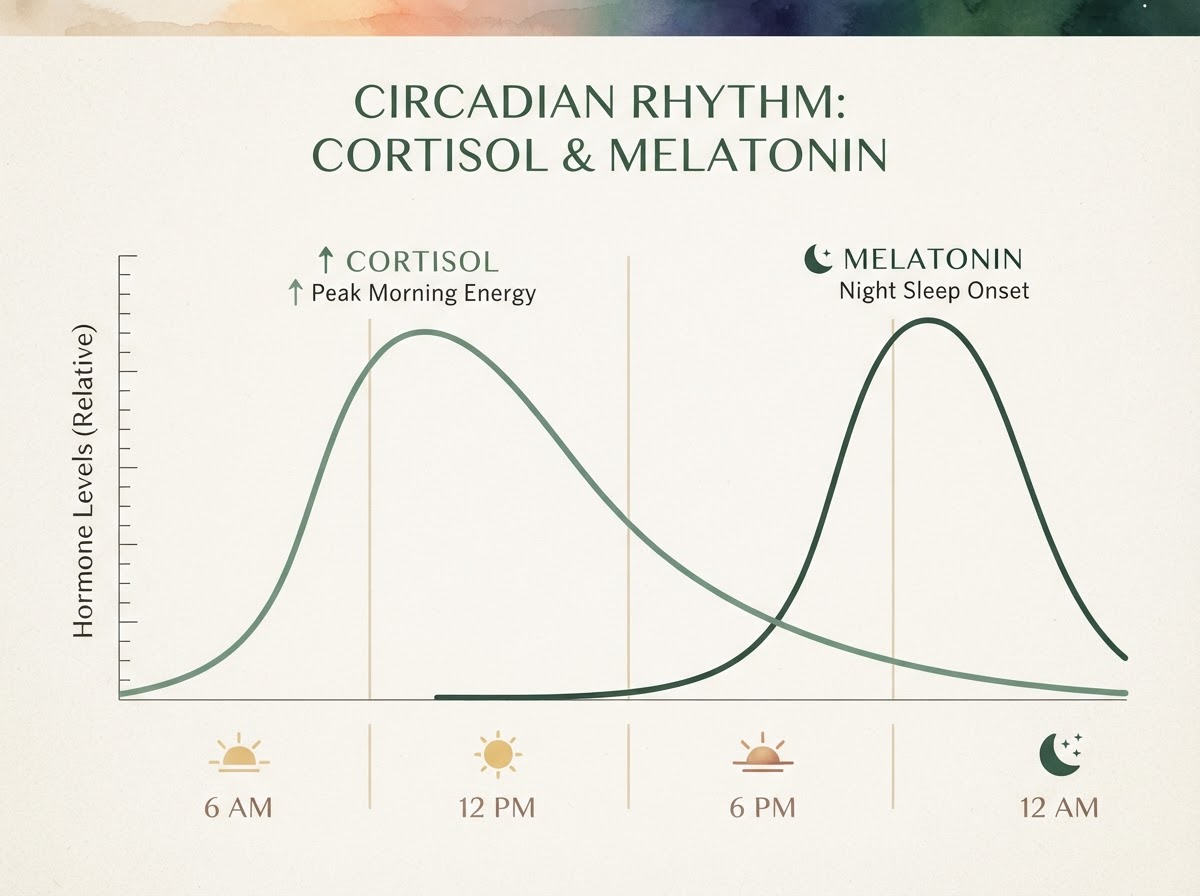
In this package, every sample is anchored to YOUR wake time, not the clock's. That single decision is what makes the results interpretable, and it is why the assessment is done alongside the pathology.
Rhythm, and everything that shapes it.
Your timing.
A structured chronotype assessment, your "sleep midpoint", and your "social jetlag" the recurring gap between your body clock and your alarm clock. This figure alone often explains more than anything that follows.
Your rhythm.
Cortisol, cortisone and melatonin measured across four points of your day, producing a curve rather than a number. It shows the shape of your rhythm, its timing, and where it has flattened or shifted.
Your foundations.
Standard pathology reviewed: iron studies, thyroid function, glucose and insulin, lipids, vitamin D, B12 and inflammatory markers. Ordinary causes of fatigue get ruled out before anything more specialised is considered.
Your context.
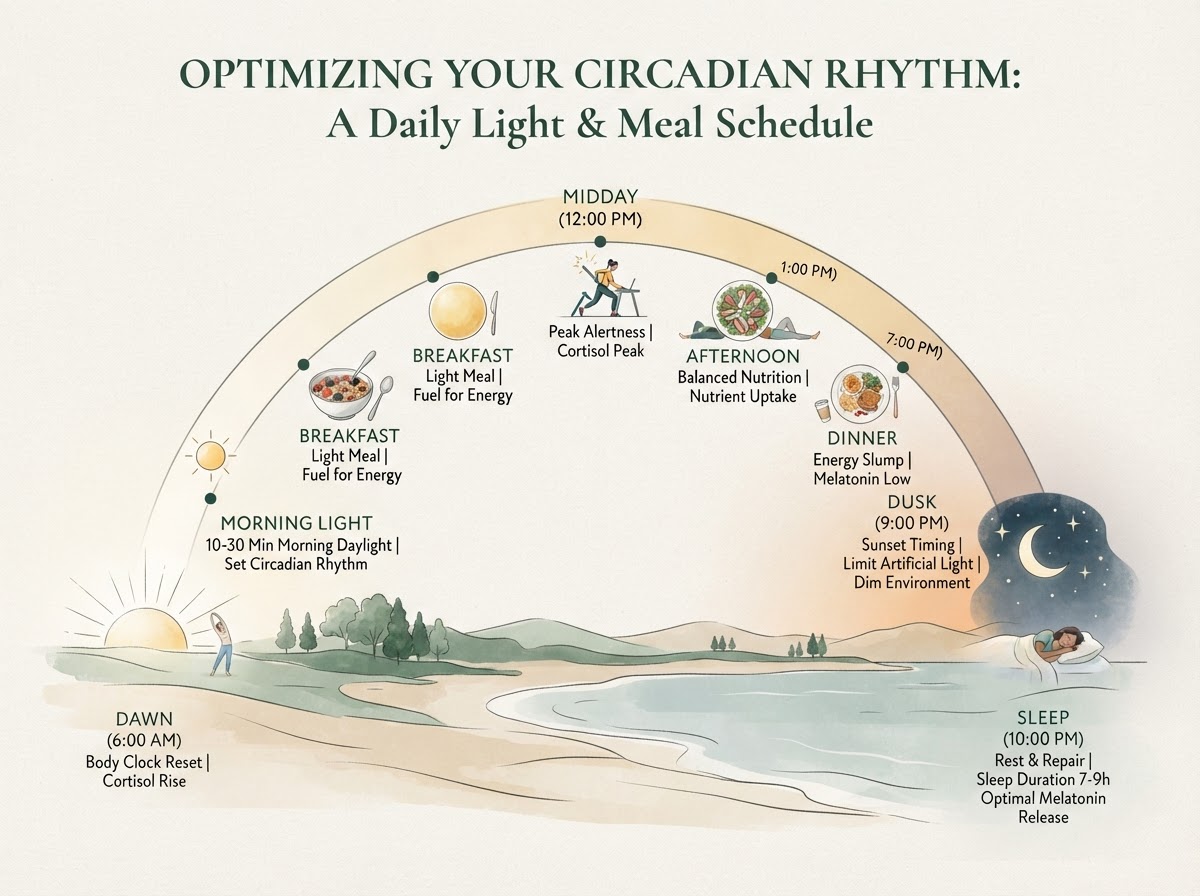
Light exposure, meal timing, caffeine and alcohol architecture, training times, travel and work patterns. Your lifestyle habits that influence the rhythm, and the ones you can actually change.
Two versions, because the physiology genuinely differs.
This is not a marketing distinction. Male and female circadian assessment ask different questions and require different timing.
For men
Testosterone follows a strong daily rhythm and its production depends on sleep. Sustained sleep restriction measurably lowers daytime levels in healthy men. (This means a low result in a chronically sleep deprived executive is often a sleep finding before it is an endocrine one. Measuring it without that context invites the wrong conclusion).
This version also screens carefully for obstructive sleep apnoea, which is more common in men, frequently undiagnosed, and produces precisely the unrefreshing sleep and daytime fatigue this package investigates. Where it is present, it needs to be addressed first, you can't supplement your way out of sleep, no amount of nutritional or timing work substitutes for treating it.
Alongside: metabolic and cardiovascular markers, iron status, thyroid function, and the two levers most often overlooked in this group, alcohol, and training at nine o'clock at night. We need to consider the basics, as they affect our sleep ability and quality.
For women
Female assessment carries a second timing axis. Sleep and hormones interact across the menstrual cycle, so testing has to be anchored both to your wake time and to where you are in your cycle. Ignoring these means the results cannot be read properly.
It also accounts for what actually changes across life stages. In the luteal phase, rising progesterone lifts core body temperature and measurably degrades sleep quality. It might be understanable if one week our of four legitimately your sleeping is worse, this is physiology, not failure. And through perimenopause, disrupted sleep is very often misread as "becoming a night owl" when it is something quite different: fragmented sleep with intact circadian timing. Those two findings look similar and need entirely different responses.
Iron status is given particular weight here. Ferritin can sit inside the reference range while remaining low enough to cause fatigue, poor concentration and restless legs, and restless legs disrupt sleep. It is the most common reversible finding in this group, and among the most frequently missed.
Four steps.
Initial consultation
A full history, your "chronotype" and sleep assessment, and an audit of light exposure, meals, movement and substances. (Your chronotype is the behavioural expression of your internal body clock.)
Testing
Functional pathology ordered through private reputable labs, test kits sent to you directly. You receive precise collection instructions timed to your own waking hours. (Standard pathology through your GP where Medicare criteria are met, refunds may apply if this is done prior to ordering, discuss with the team).
Results consultation
Your rhythm mapped and explained, alongside everything else measured. You leave with some guiding steps on how to improve on what comes naturally to you.
Review
At eight to twelve weeks. Option to retest only where a decision depends on it. Fees are calculated and discussed where indicated.
What you receive.
- ✦ Two consultations, plus your written circadian and nutritional plan
- ✦ A chronotype and social jetlag assessment specific to you
- ✦ Individually timed collection instructions
- ✦ Full interpretation of standard and functional pathology
- ✦ A staged six-week protocol covering light, timing, nutrition and movement
- ✦ Review consultation at eight to twelve weeks
Investment: Consultations are charged at standard rates. Laboratory fees are passed through at cost, with a flat $300 clinical review and interpretation fee applied per package. You will have a clear figure before anything is ordered — no test is requested without your agreement on both its purpose and its cost.
Who this is for.
- • High performers whose energy, focus or sleep no longer match the demands on them
- • People who have been told their results are "normal" but do not feel normal
- • Shift workers, frequent travellers, and anyone whose schedule fights their biology
- • Women navigating cycle-related or perimenopausal sleep disruption
- • Men whose fatigue has been attributed to age without much investigation
Who it is not for.
I would rather say this plainly than have you spend money on the wrong thing.
This package assesses and supports circadian and nutritional health. It does not diagnose or treat disease, and it does not replace medical care. If you have symptoms that suggest a sleep disorder, a mood disorder, or an undiagnosed medical condition, the right first step is your doctor — and where that is what I find, I will tell you and refer you.
I also do not use test panels that lack a credible evidence base. Several popular ones are excluded from this package deliberately. If a test cannot change what we do next, I will not order it.
Frequently Asked Questions
Precision beats guesswork.
If you have already tried the supplements, the sleep apps and the earlier alarms, and something still is not right — the missing variable may not be what you are doing, but when you are doing it.